



Cellar Access
Cellar Access
Cellar Access
Cellar Access
JUNE 2024 - CELLAR ACCESS!
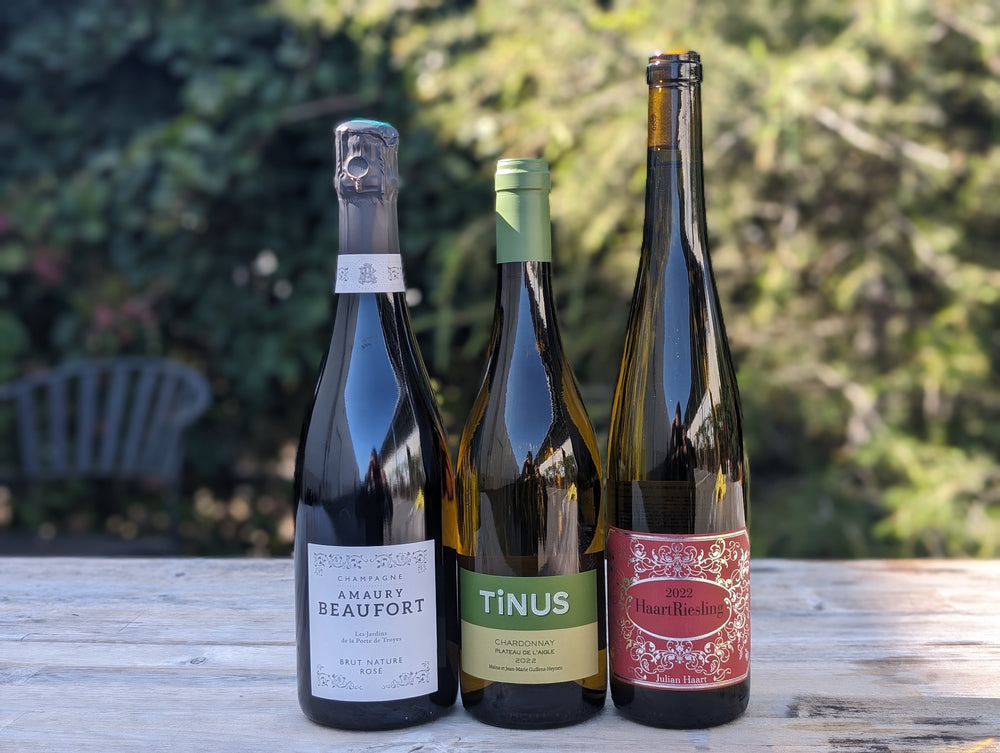
With Summer closing in, the need for effervescent, refreshing wines intensifies; with our storefront finally opening, that calls for supremely elegant and delicious Champagne! Alongside the can't-get-enough freshness of the Tinus Chardonnay from our friends at Guffens-Heynen, we're bringing you one of our absolute Champagnes that you should feel free to drink like you would a top Burgundy - let the Beaufort open in a true wine glass, even a Burgundy glass, and let its charm and complexity amaze you. Don't worry, the Beaufort has plentiful dark fruits and salty hints to satisfy your need for a red, all the while keeping you sated and refreshed. Finally, for either your poolside dates or as a serious counterpart to sushi, salads or really any meal, the HaartRiesling from Julian Haart punches way above its weight, delivering a concentrated burst of salty, fruity goodness.
To your health!
This wine has a per person limit. We do this as the wine is hard to find, very rare and/or incredibly sought after.
We do this to ensure that we are able to share the love with everyone!
We kindly ask that you do not abuse this limit by placing multiple orders. In the event that you place multiple orders - they will be canceled and subject to a 5% cancellation fee.
If you would like to request more than the allowable amount - we may be able to help - send us an email at info@thatcherswineconsulting.com

Julian Haart’s HaartRiesling grapes come from old vines planted in soils rich in slate, grown according to organic principles. The wine undergoes whole cluster pressing with fermentation and aging occurring in traditional 1000-liter foudre.
The HaartRielsing is a taut white with sharp acidity and crunchy, fresh structure. Notes of almond cream, yellow peach, candied citrus, spices, and mint permeate the aromatics. On the palate, the juicy fruit is beautifully complemented by smoky herbs and fresh acidity. The wine is wonderfully concentrated and structured on the palate.
Julian Haart, that is - the prodigious German winemaker who somehow already has a decade of vintages under his belt after working beneath two behemoths: the living legends Egon Müller and Klaus-Peter Keller.
Julian Haart
Training in any profession is important. Just like we sommeliers and former hospitality pros were poked and prodded for "star hunting", or shipping around to different Michelin-starred restaurants in lieu of a longstanding career at one of them, the future rockstars of the wine world seem determined to seek out differing beliefs and methods to learn from while they hone their own eventual vinous vision. So it is that Julian Haart spent time with two luminaries of Germany in Egon Müller and KP Keller - producers of many of the most sought-after (and pricy!) wines in the world!
Julian's first vineyard purchase was in the Grand Cru Ohligsberg; he followed this with the purchase of a parcel in the 75+ year-old, terraced Goldtröpfchen ("droplets of gold"); Schubertslay, home to century-old, ungrafted vines came a year later, a whole one hectare of vines (that's like a midwesterner's front yard). In 2018, Haart graciously gifted Schubertslay to Klaus Peter Keller in return for access to Keller's Frauenberg vineyard.
Julian's wines have garnered acclaim around the globe, and cult-like status with smart collectors who believe his wines possess unrivaled purity and class. Equally astute with dry as well as off-dry and sweet styles, Julian has even tried his hand at Pinot Noir, as well! Safe to say, whatever he creates we will seek out!
"Julian's red label bottlings are playful, fresh and graciously showcase the talents of this young winemaker," Doug continued. "Although these cuvees are not a part of the Prädikat system, they still represent the region beautifully."
This wine has a per person limit. We do this as the wine is hard to find, very rare and/or incredibly sought after.
We do this to ensure that we are able to share the love with everyone!
We kindly ask that you do not abuse this limit by placing multiple orders. In the event that you place multiple orders - they will be canceled and subject to a 5% cancellation fee.
If you would like to request more than the allowable amount - we may be able to help - send us an email at info@thatcherswineconsulting.com
NV Amaury Beaufort, Brut Nature Rose Base 2020


NV Amaury Beaufort, Brut Nature Rose Base 2020
From 50+-year-old Pinot Noir grown in the vineyard of Le Jadinot in the Aube commune of Polisy. The southeast-facing vines are grown on limestone-rich Kimmeridgian clay soils. The wine is aged for 12 months in large, new oak foudres and later for five months in old, neutral barrels. The wine spends 22 months in the bottle on the lees.
ASSEMBLAGE 100% Pinot Noir
VINE AGE 30 years old
SOIL Kimmeridgian
ELEVAGE 23 months in foudre, 22 months on the lees. Zero sulfur added.
DISGORGEMENT 09.11.2023, zero dosage
BOTTLES PRODUCED 2359 bottles
Amaury farms a single hectare of vines in the Aube, and if you didn't see the final product you would think he were crafting world-class Burgundy.
Amaury Beaufort
You may know the Beaufort name from the family domaine located in Ambonnay. Despite the lineage, Amaury didn't take over the estate, but rather picked up and moved to the Aube. If there is something of note that Amaury has taken with him, it's the dedication to the vineyards. They have been farming the vineyards without any chemicals since 1969.
Amaury has been working in wine since 2003 and his first vintage of his own label was 2018. He farms 1ha in Polisy called "Le Jardinot '' all by himself. This is important to Amaury as he wants to ensure he is doing the entire process from vineyard to bottle. Amaury think's 1ha is enough because he treats it as his own garden. As he's recently begun crafting wines from his friends' vineyards as well, he's ensured they share his continued quest for quality control, and the results show.
Viticulture and Vinification
Higher rolled canopies to allow for ripeness, maturity, and sugar levels. Canopies are dense, with more leaf content as Amaury feels this supports the roots in diving deeper into the soil for nutrients. All the wines are made without sulfur. With his close proximity to Burgundy, Amaury’s vinification techniques are more similar to Burgundy than classic Champagne. Fermentation begins in large 15hl oval casks. The barrels are all treated with light steaming to remove the concentration of toast and oak flavors.He doesn't do batonnage by hand, the shape of his casks allows for natural batonnage. The wine is then transferred to Demi-muids for settling and further aging. Elevage is rather long and changes vintage to vintage.
See More at Thatcher's ImportsThis wine has a per person limit. We do this as the wine is hard to find, very rare and/or incredibly sought after.
We do this to ensure that we are able to share the love with everyone!
We kindly ask that you do not abuse this limit by placing multiple orders. In the event that you place multiple orders - they will be canceled and subject to a 5% cancellation fee.
If you would like to request more than the allowable amount - we may be able to help - send us an email at info@thatcherswineconsulting.com
2022 Chateau des Tourettes (Maine et Jean-Marie Guffens-Heynen), Tinus Chardonnay Plateau de L'Aigle, VdF

2022 Chateau des Tourettes (Maine et Jean-Marie Guffens-Heynen), Tinus Chardonnay Plateau de L'Aigle, VdF
Sourced from the Chateau de Tourettes ' Luberon vineyards in the Southern Rhone at 400 m above sea level. The name roughly translates to "a plateau of the eagle, " which hints at its higher elevation. The soils are rich in limestone, perfect for Chardonnay. The wine is produced using only the first press juice for the desired elegance and is first fermented & aged in 25% new oak barrels, followed by a few months on fine lees in barrels and concrete vats. The wine has a very expressive nose with toasted aromas and some reductive characteristics, followed by minerality and fresh herbs. The palate is suave and mineral at the same time!
Guffens-Heynen
The year is 2020. Guffens-Heynen wines had been absent from the US market for over a decade; however, they remained one of the most sought-after domaines for true, ear-to-the-ground Burgundy collectors. We had enjoyed various vintages in Europe and Japan, but due to the 10 year gap of not having a US importer, we wanted to seek out the wines and understand them a bit more. A close friend in the know introduced us; arriving at the estate for the initial visit, we soon spent nearly 9 hours conversing about wine and life.
Coming away from this experience, we realize that we talk so much about focusing on young winemakers who are helping to re-define the future of winemaking – winemakers who are making bold, yet smart changes, and practicing healthy viticulture. It may not seem that Jean-Marie fits into this category, but he does in more ways than one! Jean-Marie and his wife Maine settled in Vergisson in 1976. Despite making wine since 1980, and quickly gaining attention with the banner 1982 vintage, so many of our best collectors had never heard of the estate. With the emphasis today on buzzwords of "sustainable" and "biodynamic" – words so often possessing true value in the right hands – we instead find Jean-Marie Guffens who cannot be defined by either a grape, region or method, and certainly not a region. He is a style unto himself.
After arriving in Vergisson from Belgium, Jean-Marie and Maine immediately immersed themselves in learning about winemaking and acquired their first plots of Pierreclos in 1979. Since the early 80s, Jean Marie has been pushing to prove that great Chardonnay doesn't solely come from the Côte de Beaune, nor does it have to have a Premier or Grand Cru designation on the label. His first official vintage was 1982, with the wines from Vergisson, followed by starting the negociant label Verget in 1990, which has in and of itself gained significant acclaim.
Viticulture & Vinification
Guffens believes in making honest wines, and is propelled by the belief that his region of Mâcon can create wines of legendary quality; judging by some of the remarks of critics over the last few decades, few disagree with Guffens at all. Through his varied trials in the vineyards, Jean-Marie's methodologies were firmly in the camp of "less is more" - in fact, he coined the term "non-cultivation" to describe his approach. Whereas many a vigneron would have manicured the vine rows and ploughed regularly, Guffens would instead only plow once and very shallow, and continue to mow the cover crop throughout the year while allowing the vine to be "guided, not restrained." His argument is that maintaining the grass through the year, rather than ploughing it in will both reduce soil compaction and limit nitrogen; the resulting grapes are higher in acidity, smaller (leading to more concentration), and in conjunction with not de-leafing or hedging (which stimulates growth), promotes the vine churning all of its energy into the fruit.
The result? Guffens' clusters are wildly small with tiny grapes; yields are routinely around 37-38 hectoliters per hectare, and the small grapes lend a higher ratio of solids-to-juice; this means more dry extract, or, in more everyday terms, a less dilute and more concentrated flavor. Ripeness is always desired, and so there will be repeated "tries" through the vineyard over multiple weeks to ensure the clusters are picked at ideal times. In total, the Domaine wines’ now consist of 5.65 hectares in Vergisson, Pierreclos, and Davaye.
As important as picking ripe grapes is in the vineyard, pressing may be one of the most crucial parts of winemaking to Jean-Marie. The grapes are lightly crushed before being pressed. In the winery a modified Coquard press is used; this is also uncommon in Burgundy but more common in Champagne where delicacy is the name of the game. Much like Champagne, where the press cycles are intended to be separated by the regional laws, Jean-Marie separates his free-run juice – the juice provided only by the weight of the grapes themselves – and the different cycles of the press; by doing so, he is able to create his wild array of wines that are kaleidoscopic in flavors by virtue of varying levels of density via the pressure under which the grapes were squeezed.
For the most prized vineyards, the free-run and first-press juice is of utmost importance as it is both delicate and low in pH – meaning high-acidity – which is hugely important for wines of such ripeness as the Guffens wines are. In short, sorting, fermenting and blending are performed intuitively, which is mirrored by the creative labeling that knows no bounds. Certain vineyards and wines are routinely repeated – Croux et Petits Croux, Juliette et les Vieilles de Chavigne, etc. – but there are no limits to what Guffens and his winemaker, Julien, can create in any given vintage. The top wines routinely are fermented in barrel, while the young-vine plots will be fermented in concrete. A varying amount of new oak is used, while bâtonnage is performed multiple times throughout to stimulate a healthy culture in the wine. Ultimately, as Guffens says, each wine "began with an idea." To translate that, no wine is formulaic; the signature here is that of vibrancy, feeling and a true sense of spirit, if not place.
We should note that, as with the wines of Guffens, for Verget, Closiot and Chateau des Tourettes, there is not a formula by which either the winemakers or we as the importers can provide a simple, bulleted list for each wine. Thus, we have made each and every wine's description a bit of a conversation, and include bits of Jean-Marie's notes from his yearly letter which we are happy to share below.
JEAN-MARIE GUFFENS' NOTES ON THE 2025 VINTAGE
"2025 was a year of challenges and changes for me. Having made wine for so many years, I've unknowingly grown old. So, before I get too old, I've decided to focus on the future of my various creations.
The harvest is unfortunately very poor [small] for the second year in a row. But the concentration of the wines is enormous.
JEAN-MARIE GUFFENS' NOTES ON THE 2024 VINTAGE
"The harvests were very small at all three estates. At Domaine Guffens-Heynen, Julien has been in charge of the day-to-day management for the past year and assists me during the winemaking process. Our collaboration couldn't have been better, as the vintage was very complicated. Thanks to the improvements he proposed and organized in harvest reception, we were able to harvest each plot on the right day. This allowed us to double the daily harvest while reducing the workload, all without changing our philosophy. The result is astounding. The few people who have tasted these wines have all been dazzled by the precision on the nose, the fruity attack, and the length on the palate. I thought we could do as well as in 2014, but I'm sure we'll surpass it."
JEAN-MARIE GUFFENS' NOTES ON THE 2023 VINTAGE
Dear friends,
I'm not going to repeat Julien's comments on the climate from last year. Ultimately 2023 is in every way similar to 2015, 2016, 2017, 2018, 2019, 2020 and 2022. It gets complicated and boring.
The 2023s had a lot of water in the spring which avoided some water stress. For the rest, we once again went from a large harvest to a normal harvest due to the extreme heat which once again caused a blockage of ripeness. The vintage is, however, less marked by these conditions and is more similar to the 2020s than the 2022s. We can therefore speak more of a year of terroir than of heat. And so much the better.


